
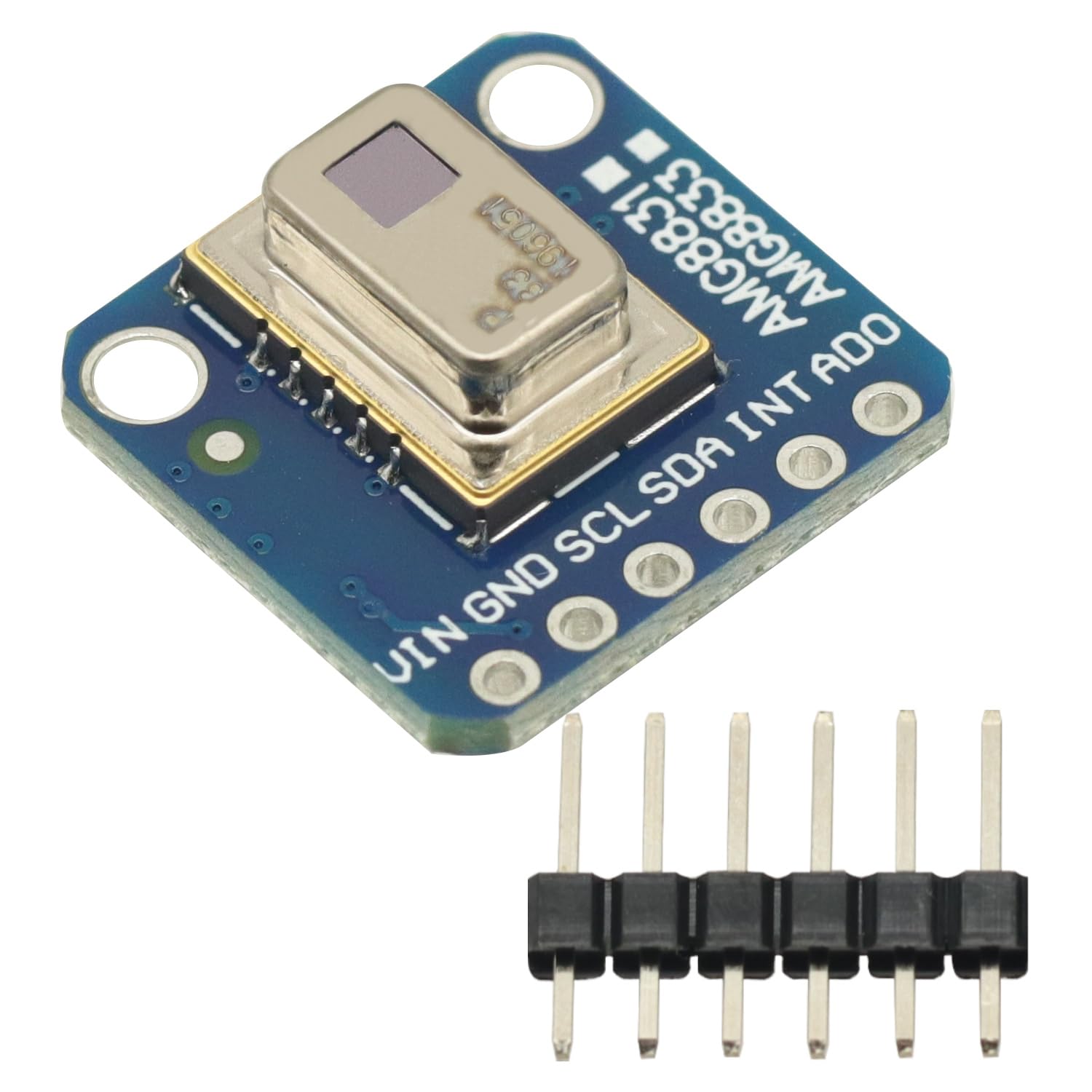
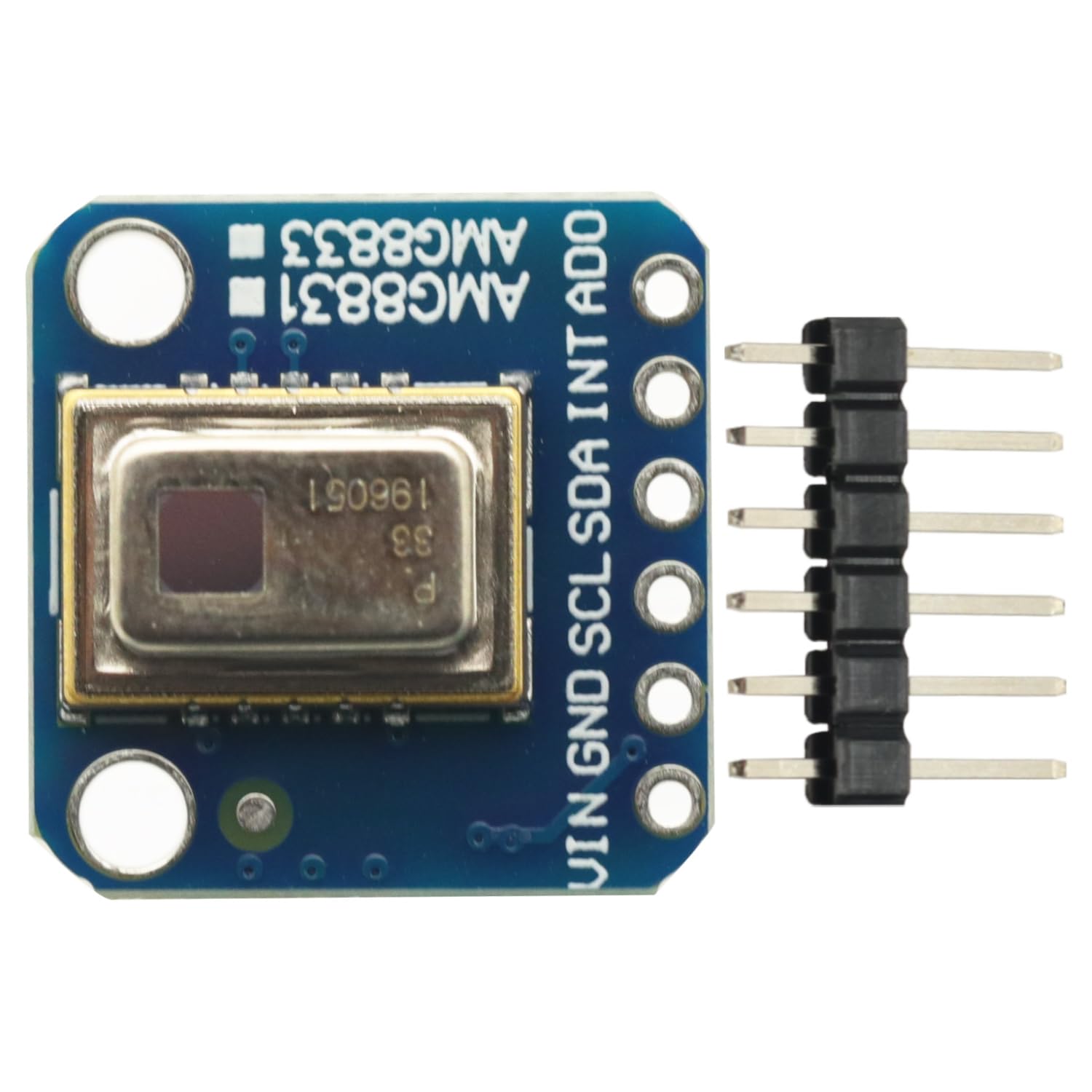
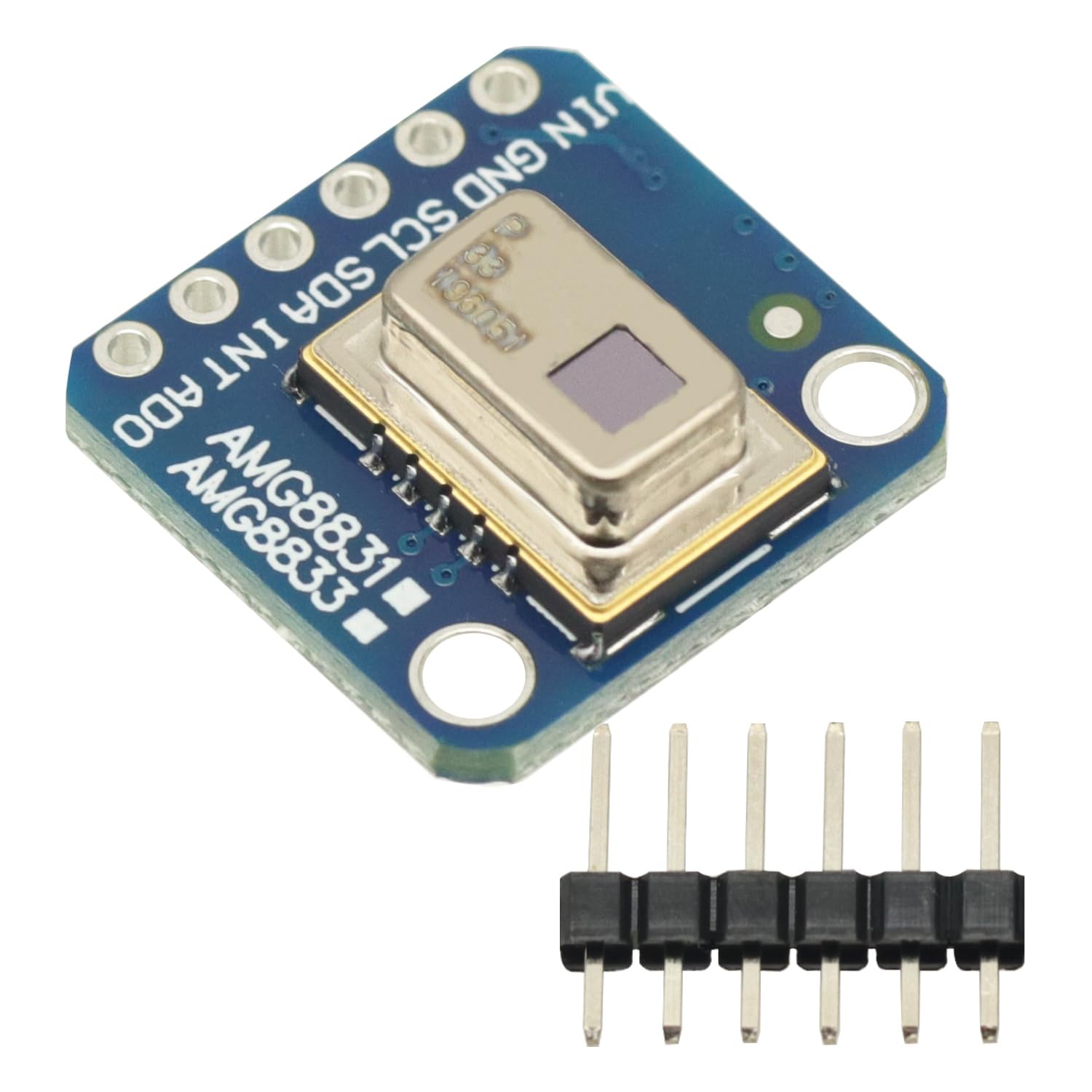


The AMG8833 (often sold as Grid-EYE) is an 8×8 infrared (IR) thermal imaging sensor that outputs temperature readings from a grid of 64 thermal pixels. It’s popular for hobbyist thermal imaging projects because it’s affordable and easy to interface with microcontrollers and single-board computers.
📌 Key Specifications
-
Sensor type: 8×8 pixel IR thermal array
-
Temperature measurement range: ~ 0°C to 80°C (32°F to 176°F)
Note: Some modules can detect slightly broader ranges depending on calibration and environment. -
Interface: I²C (uses SDA/SCL lines for data communication)
-
Supply voltage: 3.3 V – 5 V
-
Maximum frame rate: 10 Hz (10 readings per second)
-
Pixel resolution: 64 thermal pixels
-
Typical use: People/heat detection, simple thermal mapping, proximity sensing
🛠️ How It Works
The sensor detects infrared energy (heat) across its 8×8 grid. Each pixel reports an estimated temperature value, creating a low-resolution heat map of the scene in front of the sensor.
You won’t get a camera-like image — think of it more like a low-resolution heat detector where each “pixel” is a temperature reading.
🧠 Typical Platforms & Usage
✔️ Raspberry Pi
-
Connect via the I²C pins (SDA, SCL, GND, Vcc)
-
Use Python libraries such as
adafruit_amg88xxorpimoroni_bme680compatible drivers -
Commonly paired with libraries like Matplotlib to visualize the thermal data as a colored heat map
✔️ Arduino
-
Works with standard Arduino boards using I²C (A4/A5 on Uno, etc.)
-
Often combined with Adafruit’s AMG88xx library
-
You can print temperature grids to the Serial Monitor or send to a display
📊 Common Example Outputs
-
Heat maps showing relative temperatures (hotter areas in red/yellow, cooler in blue)
-
Temperature grids (8×8 values)
-
Simple object detection based on temperature thresholds (e.g., human detection)
📌 Pros & Limitations
👍 Pros
-
Affordable thermal sensor
-
Easy to connect via I²C
-
Works on 3.3 V and 5 V systems
-
Reasonable update rate for hobby projects
👎 Limitations
-
Low resolution (8×8) — no detailed thermal images
-
Max 10 Hz frame rate
-
Accuracy can vary depending on calibration and environment
🧩 Pinout Summary
| Pin | Function |
|---|---|
| VCC | 3.3 V–5 V power |
| GND | Ground |
| SDA | I²C Data |
| SCL | I²C Clock |